Ladybird Shipped a Fourth Engine and It Kind of Works
Published Nov 26, 2026Updated Nov 26, 2026Dishant Sharma6 min read
A guy on Hacker News installed the Flatpak build, opened his own web apps, his news sites, and Hacker News itself, then wrote that he was completely dumbfounded. He had been told for decades that building a new browser was like tilting at windmills. Every site he cared about rendered correctly.
i spent an evening reading the 630 comments under that thread instead of doing my job. The reaction kept pulling me back, because it was not the usual cynical sneer.
"This actually worked amazingly well," one person wrote. Another said it was sipping 53MB of memory with multiple tabs open. A third complained that scrolling felt slightly jerky.
Ladybird shipped its first alpha on November 23, 2026. macOS and Linux only. Backed by a 501(c)(3) non-profit.
An engine built from scratch, not a fork of Chromium, Gecko, or WebKit.
What it actually is
Three engines run almost everything you read. Blink powers Chrome, Edge, Brave, and Arc. WebKit powers Safari.
Gecko powers Firefox. Ladybird is the fourth, and it is genuinely new code.
It grew out of SerenityOS, the hobby operating system Andreas Kling started. He is president of the non-profit now.
The engine handles HTML parsing, CSS, layout, and JavaScript itself. It borrows libraries for the boring parts, like Skia for 2D graphics.
And no, it is not a reskin. The project's own words: "A new engine written from scratch. Not a fork of Chromium, Gecko or WebKit."
A fork inherits the architecture and the bugs of its parent. A new engine inherits nothing but the standards.
Why a fourth engine matters
Here is the argument that convinced me.
The web is the most important platform in computing, yet only a small number of browser engines power the entire thing, each controlled by a company with its own agenda.
Google ships a browser and sells ads. Apple ships a browser and protects its App Store. Mozilla takes money from Google to be the default search.
None of that makes them evil. All of it means the engine has a business attached.
Ladybird's promise is the absence of that business. No default search deals. No crypto tokens.
No user monetization of any kind. Just a browser, and nothing else.
The antitrust angle is not abstract. When one engine has the market share, sites get built against its quirks and everyone else pays a compatibility tax. A fourth engine passing the same suite is a check on that.
Project figures from the end of October 2026:
| Browser | Engine | Subtests passed |
|---|---|---|
| Chrome | Blink | 2,244,397 |
| Firefox | Gecko | 2,189,315 |
| Ladybird | Ladybird | 2,184,722 |
| Safari Tech Preview | WebKit | 2,172,990 |
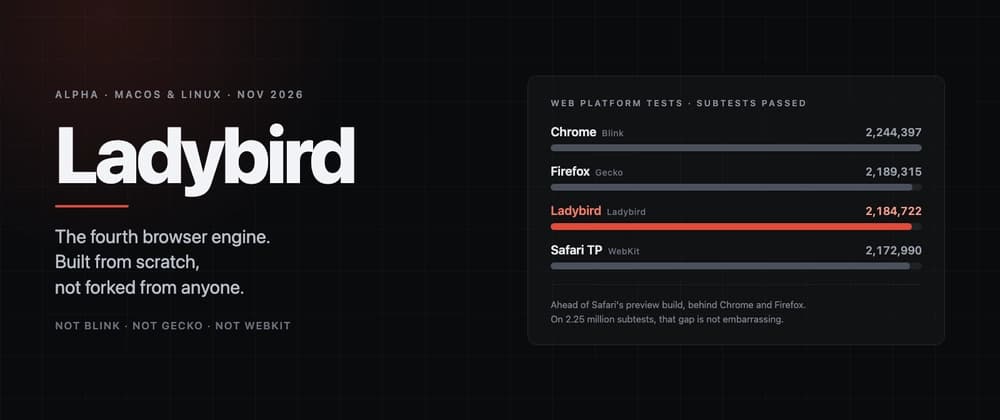
Ladybird sits behind Chrome and Firefox, ahead of Safari's preview build. On 2.25 million subtests, that gap is not embarrassing.
The honest state of the alpha
Kling's post does not oversell it. "This is an alpha, so some websites won't work, and it will crash sometimes."
You can report a broken site from inside the browser. After a crash, you can read the report before deciding whether to send it.
The security section is the part i respect most, and the part that should keep you off it.
We want security nerds to hack it! A new browser gets hacked, over and over, and that's part of the process, so we make no promises about security today.
Disclosures go to SECURITY.md on GitHub.
And people took the invitation seriously. One commenter said he pointed a small model at the sandbox and TLS code for five minutes and found a buffer overflow plus a timer that was started and never fired. He also flagged a macOS sandbox rule that granted filesystem writes just to get audio working.
Could be wrong. Could be a bad faith read. But it fits the alpha framing exactly: the hardening has not happened yet.
Simon Willison tested it on launch day. He called it fast with a lightweight UI, and most sites worked. Then he said he would not sign into GitHub or Gmail with it.
What it gives developers
The alpha earns its keep here even if you never use it as a browser.
It supports WebDriver for automated testing. It also speaks the Firefox DevTools protocol, so tooling built for Firefox has a path in.
If your site only works in Chrome, you probably do not know it. You have been testing against Blink for years and calling it the web.
Drop your staging URL into Ladybird and watch what breaks. CSS that leans on a Blink quirk will show up. So will layout hacks that assume one engine's bugs.
That is a cheap audit for a bug class you cannot see any other way.
git clone https://github.com/LadybirdBrowser/ladybird.git
cd ladybird
./Meta/ladybird.py run
The alpha channel updates automatically now, which Kling called the part he is most excited about. Full build docs live in the repo.
The agents angle
Browser agents need a browser they can drive. WebDriver support means CI runners and automation frameworks can point at Ladybird the same way they point at Chrome. A genuinely independent engine in that loop catches sites that only work in one place.
That changes reliability claims. If your agent passes in Chrome and fails in Ladybird, you learned something real about your assumptions.
There is a bigger debate underneath. The WebMCP conversation and the argument about how agents should actuate a page assume a small set of engines. A fourth engine changes who has to implement those interfaces, and how fast.
i do not know how that plays out. Nobody does. But more implementations of one standard is usually better than fewer.
The money problem
Ladybird is funded entirely by donations and sponsorships. Platinum is $100,000, Gold $50,000, Silver $10,000, Bronze $5,000, Copper $1,000.
The sponsor list is a strange mix: Mitchell Hashimoto, Paul Copplestone, The Primeagen, and someone listed as "Anonymous Chromium Developer."
Sponsorships run for a year and are unrestricted. The project says board seats are not for sale and sponsors get no say in the roadmap.
Right structure. Also the hard part. A non-profit competing with trillion-dollar companies has to keep raising money without selling the thing that makes it different.
The messy history
The project has changed its mind in public, which i take as a good sign.
It announced Swift as its C++ successor in 2024. In February 2026 it closed that plan. GitHub issue 933 drew 328 points and 315 Hacker News comments, most of them arguing about it.
Then it adopted Rust instead, and ported 25,000 lines of its JavaScript engine in two weeks with Claude Code and Codex. That is either impressive or terrifying depending on your mood.
The roadmap since has been relentless. Real websites in January. A hand-written assembly interpreter in March.
An inline PDF viewer in April. Cloudflare Turnstile and a Rust HTML parser in May.
Sandboxing and GPU isolation in June. A new style engine in August.
And someone ported the whole browser to WebAssembly for $552. i have questions and no answers.
The random break
Sometime in October 2024, the team ordered a pizza with Ladybird. That detail stuck with me.
You cannot order a pizza without a working payment flow, a working form, a working layout engine, and a JavaScript runtime that does not fall over. Somewhere a person typed a card number into a browser a small team wrote from nothing, and a pizza showed up.
People build hobby operating systems for the same reason people climb things. The point is that the thing did not exist and now it does.
i have a folder of alpha browsers i installed and never opened again. This one is different, and i am not fully sure why.
The real talk
Most people should not install this. If you bank in your browser, keep banking in Safari or Chrome.
There is no mobile build and no plan for one soon. The team is focused on desktop macOS and Linux, with Windows "planned for a later stage."
And the skeptic's case is strong. Alpha software that admits it will be hacked is not a daily driver.
A browser that needs years of hardening cannot skip the years. No amount of WPT passes fixes that.
So try it as a second browser. Test your site in it. File a bug.
Then go back to your real browser and wait.
The ending
What gets me is not the test numbers. It is the person who opened his own web apps on day one and expected nothing.
Decades of being told this was impossible, and then it just worked. Mostly. With a little jerky scrolling.
The interesting question is not whether Ladybird beats Chrome. It will not, not this year.
The question is whether a fourth engine can stay alive long enough to matter. i want to find out.