Someone on Reddit signed up for a Claude subscription to try Claude Design. They hit their weekly quota after two prompts. Two prompts.
The thread was full of people nodding along. The hype was enormous. The limits were real.
Claude Design launched to massive noise. The demos looked incredible. Full web prototypes from a single prompt.
Mobile flows. Slide decks with WebGL backgrounds. But people hit a wall fast.
Cloud-only. Locked to Anthropic's model. A paid plan that runs out of quota way too fast.
One user on r/ClaudeAI described it as a tool crippled by bugs with a brutal usage limit.
That is when Open Design showed up.
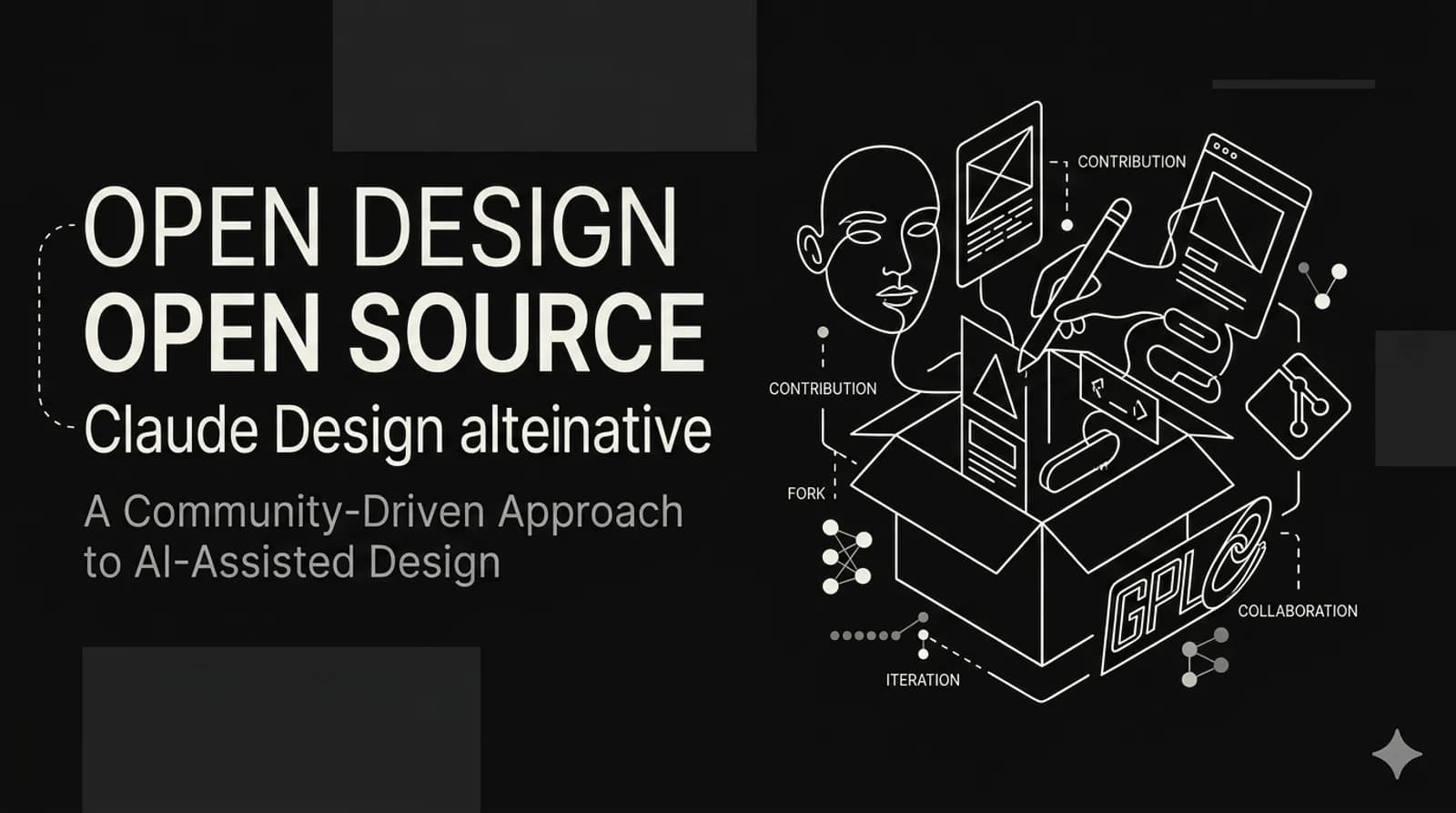
The nexu-io team released Open Design as the open source, local-first alternative. Apache-2.0 license. Your own agent and your own API key.
Within days it had 18,000 stars. Now it sits at over 55,900 on GitHub. Better Stack made a video asking "Why 40k Developers Abandoned Claude Design."
The timing was not a coincidence.
What it actually does
Open Design turns your coding agent into a design engine. It auto-detects the CLI agents you already have. Claude Code, Cursor, Codex, Gemini, Qwen, OpenCode.
12 adapters now, and it detects them automatically on boot.
Clone the repo, run pnpm install, then pnpm tools-dev run web. A local SQLite daemon and web UI spin up. No cloud and no subscription.
You can run it on a VPS or your laptop.
Here is what ships:
- 139 skill bundles (file-based SKILL.md files)
- 150 portable DESIGN.md systems for Linear, Stripe, Vercel, Apple
- MCP integration so your editor reads design files directly
- BYOK at every layer, any OpenAI-compatible API
The MCP integration is what people keep coming back to. A Reddit user called it "the part worth paying attention to." Drop it into Cursor or Windsurf and your editor reads your design files.
No more copy-pasting code or taking screenshots for your agent.
The debate that would not die
The most interesting part of the Reddit threads was not the tool. It was the argument that followed. Someone called the post out for calling Open Design "free" when you still need a good model to get results.
Then it exploded.
"It's free as in speech, not free as in beer," one comment said.
"No, the tool is free. The inference is not," said another.
Dozens of comments went back and forth. People arguing semantics while the project sat there with 55,000 stars and working code. One user pointed out that even a 32B local model was not enough.
Another replied "you can say this about every self hosted LLM alternative."
The real divide is between people who think "free" means no cost at all and people who understand Open Design is a wrapper for models you already pay for.
The comment that stuck with me was someone comparing it to a free drill bit. "Is a free drill bit not free because you need a drill?" That is where this conversation landed.
But there is a real point buried in the noise. A lot of people want local-first AI tools that work with local models. And right now local models are just not good enough for design work.
That is not Open Design's fault. It is a hardware problem.
But the quality gap is real
The honest feedback from people who tried it is mixed. flickerdown said it straight: "It's not great. Cannot generate even remotely the same quality level as Claude Designer."
biglboy tried it with Kimi K2.6, DeepSeek V4 Pro, and Gemini 3.1 Flash. "Everything is looking really, really, really bad. It builds it but it is just awful."
The project is at v0.8.0. Rough edges are expected. Surgical edits are on the roadmap.
Some users hit errors loading preview frames. Getting Ollama or llama.cpp to connect has also been hard for some.
But Claude Design has its own problems. Users describe it as having "more bad days than good," being "fucking awful for exporting," and breaking into a "black screen of death."
The gap between them is not as wide as people think.
One user pointed out that Open Design lets you use models like Kimi K2.6. Those are "10x cheaper and very close to Opus 4.7" for design work.
The value equation depends heavily on which model you pair with the tool.
What the architecture buys you
The BYOK approach is what makes this interesting long term. Models shift every few weeks. A new model drops, a better one appears, prices change.
Locked into Claude Design? You wait for Anthropic. Use Open Design and plug in the new model.
A Reddit comment put it well: "BYOK is the part that matters long term. Models shift every six weeks and getting locked into one vendor's prompt format is a real footgun."
The 139 skills are also portable. Drop a folder into the skills directory and restart the daemon. A new capability appears with no plugin store or approval process.
No vendor gatekeeping.
Prototype with Gemini Flash or a local Ollama setup. Switch to Claude Opus or Kimi K2.6 for final polish. That flexibility matters when you build daily.
Another detail that stood out: you can export projects from Claude Design as a ZIP and drag them into Open Design. The import path exists. That is smart.
Speaking of switching models
I spent an embarrassing amount of time this week trying to connect my local setup. Typed the base URL wrong. The error said "invalid or unreachable" and I stared at it for 20 minutes.
Then I realized the port was off by one.
This is the kind of nonsense that happens with local-first tools. It is frustrating. But it is also mine.
No one can throttle my port number. No one can decide I hit my limit and cut me off. I just need to type the right port.
The real talk
If you expect Open Design to match Claude Design's output quality today, you will be disappointed. It does not. Not even close, based on user reports.
The v0.8 release is ambitious but the polish is not there.
Most people should stick with Claude Design if they can afford the quota.
But here is the thing. Claude Design's value falls apart fast if you build more than a couple things a day. The quota hits, the black screens appear, and the export fails.
And you cannot fix any of it because you do not own the tool.
Open Design wins on ownership. Swap models, edit the skills, run it offline, and contribute back. That matters for building real products, not just trying demos.
The architecture is right even if the current output is not.
I keep thinking about that Reddit user who hit quota after two prompts. They paid for a subscription. They wanted to try the thing everyone hyped.
They got two uses before the door shut. Two is not a number that inspires confidence.
Open Design is not there yet. But it is local, it is open, and it is yours. When the next model drops and Claude Design's output still looks better, you just plug it in and keep going.
That is the whole point.