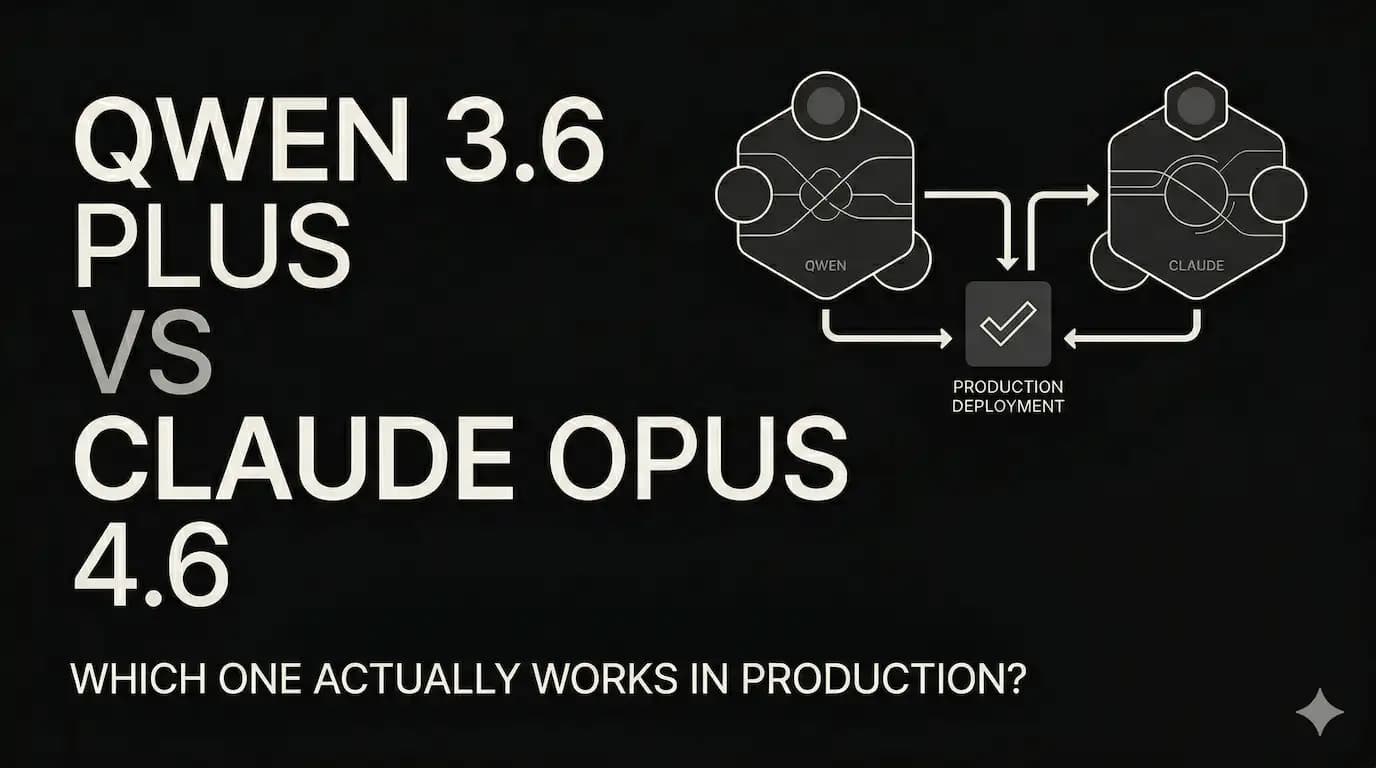
The Reddit thread went up March 31, 2026. Someone had been running Qwen 3.6 Plus on agentic coding tasks for hours. Their conclusion: "It doesn't feel like it's overthinking anymore. It just answers."
That post got traction fast. And it forced a real question back into the room. Is Qwen 3.6 Plus finally the Claude Opus 4.6 alternative that developers actually use in production?
Claude Opus 4.6 dropped February 5, 2026. A 1 million token context window. A 14.5-hour task completion window. The highest long-context retrieval score of any frontier model. And a price that makes you think twice before every API call.
Qwen 3.6 Plus showed up about 53 days later. Free on OpenRouter. Faster than anything Alibaba has shipped before. Built on a new hybrid architecture that fixed the one thing everyone complained about: it used to overthink everything.
i build AI agent pipelines. Not demos. Real production systems that break at inconvenient hours. And this question keeps coming up in engineering calls and Slack channels: which model do you actually run in production? Not on a benchmark page. In a real codebase.
The answer is more annoying than "just use Claude." But it's more useful too.
The speed thing is real
i used to think model speed was a secondary concern. You wait a bit, you get better output. Fine trade-off.
Then the numbers came out for Qwen 3.6 Plus.
Qwen 3.5 Plus averaged 39.1 seconds per response. Qwen 3.6 Plus does it in 13.9 seconds. That's not a small improvement. That's a fix.
For a 10-step agent pipeline, that difference is the gap between "this feels like a tool" and "why is my app sleeping?"
Claude Opus 4.6 has a Fast Mode. Pay \(30 per million input tokens (versus the standard \)5) and get 2.5x faster output. But that's 6x the base cost for 2.5x the speed. The math doesn't always land cleanly.
For agentic work, Qwen 3.6 Plus is now legitimately fast. Not Claude-fast by default. But close. And during preview, it costs nothing.
1 million tokens, different rules
Here's a question people always ask: both models have 1M context windows. So why does the comparison matter?
Because context isn't just what goes in. It's also what comes out.
Claude Opus 4.6 supports 128,000 output tokens. Qwen 3.6 Plus tops out at 65,536. Half. If you're generating complete migration plans, full test suites, or end-to-end documentation in a single pass, you will hit that limit faster than you think.
And Claude actually holds context better at scale. It scored 78.3% on MRCR v2 at 1M tokens. That's the highest of any frontier model at that context length. Not a marketing number. A real benchmark measuring retrieval across huge inputs.
Qwen 3.6 Plus has a perfect 10.0 consistency score, up from 9.0 in Qwen 3.5. That matters in production. Consistent wrong answers are at least debuggable. Inconsistent right answers are a nightmare.
But consistency at long-context retrieval? Not yet published for Qwen 3.6 Plus. That gap matters if your agent is reading long files.
The price problem
The first time i priced Claude Opus 4.6 for a real agent, i did the math twice. Then i just sat there.
\(5 per million input tokens. \)25 per million output tokens. Reasonable until your agent starts calling tools in loops. Each call is input. Each response is output. A 50-tool-call session compounds fast.
Someone on Reddit compared Qwen Coder Plus ($1/M) versus Claude Opus on a 500,000-token TypeScript and Python repo. The conclusion: use Qwen for the big-picture architecture because it can literally see the whole codebase at once. Use Claude for the hard single-file logic where edge cases actually matter.
Here's what the pricing breaks down to:
Qwen 3.6 Plus free tier: fast, good, your prompts train their model
Qwen 3.6 Plus paid API: pricing not fully confirmed yet
Claude Opus 4.6 standard: \(5 input / \)25 output per million tokens
Claude Opus 4.6 Fast Mode: \(30 input / \)150 output per million tokens
That free tier footnote is the annoying part. If you're building anything proprietary, you probably don't want your system prompts feeding a model's training pipeline.
Where Qwen still loses
Most tutorials tell you that newer versions fix old problems. Sometimes they do. Sometimes they just move the problem somewhere less obvious.
Qwen's core weakness is debugging existing code. Not writing new code. Writing new code, it's strong. But paste in someone else's undocumented mess and ask it to find a subtle bug, and it can quietly switch to a simpler, wrong approach midway through. No warning. Just confident, clean-looking wrong code.
i've watched a model confidently refactor three files, miss the actual bug, and then tell me it was done.
Claude Opus 4.6 is better at understanding what code was trying to do. That's the intelligence floor people keep referencing. On one Reddit thread testing both on a 500k repo, the user wrote: "When it suggests a refactor, it considers edge cases that Qwen missed."
And Claude has a 14.5-hour task completion window. The longest of any frontier model right now. For long-running autonomous agents, that's not a footnote.
But Qwen 3.6 Plus finally got to 10.0 consistency. In production, a model that's reliably right 90% of the time beats one that's brilliantly right 95% of the time but crashes unpredictably on the 96th call.
A thing nobody talks about
There's a naming pattern in AI that gets ignored. Claude is named after Claude Shannon, the mathematician who invented information theory. Opus means "a major work." Qwen means "thousand questions" in Mandarin.
One model is named after asking. The other is named after a body of completed work.
And then GPT stands for "generative pre-trained transformer." Which is just a job description. No philosophy. No mythology.
i think about this when a model confidently gives me a wrong answer in beautifully formatted markdown. It asked a thousand questions, it trained on all that text, and still told me a function returns a string when it returns void.
The naming doesn't mean anything. But it's a useful reminder. These models are predicting tokens. Sometimes they predict the right ones. The philosophy lives in the marketing decks, not the inference engine.
Who shouldn't bother
Most people don't need Claude Opus 4.6. That's the honest answer.
If your use case is documents, basic chat, quick coding help, or lightweight API wrappers, Qwen 3.6 Plus does the job. It's free. It's fast. It has 1M context. The improvements over 3.5 are real.
Claude Opus 4.6 earns its price at one specific level: complex multi-step agentic workflows, deep code reasoning on large undocumented codebases, and situations where one wrong inference breaks an entire chain. It's the model that gets edge cases right on the first try instead of the third.
But don't let benchmarks make this decision. Qwen 3 lands at 84% on MMLU-Pro, Claude Opus 4.5 sits at 89.5%. That 5.5% gap doesn't mean Claude is 5.5% better at your actual problem.
What actually translates: Claude wins when your task is ambiguous and the stakes are high. Qwen 3.6 Plus wins when you need speed, scale, and you already know exactly what you're asking for.
That March 31 Reddit thread is still up. Someone replied saying they ran Qwen 3.6 Plus on their production codebase and it found a circular dependency across four modules they had missed entirely.
And then someone else replied: "Cool. But did you pay for Claude and run the same test?"
They hadn't.
That's kind of the whole comparison in one exchange. Qwen 3.6 Plus impresses you. Claude Opus 4.6 is the thing you bring in when impressing yourself isn't enough.
Figure out which problem you actually have.