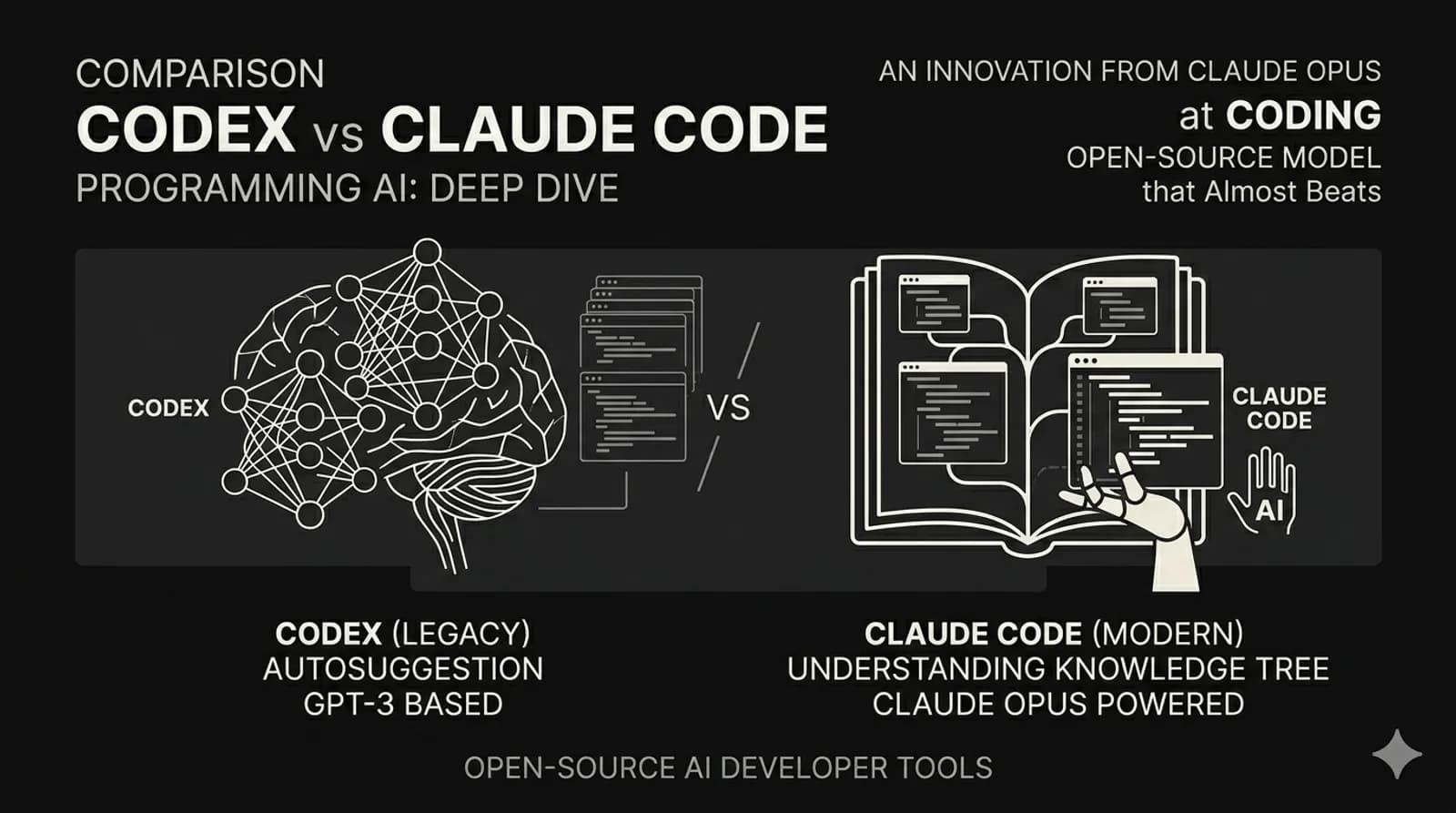
Codex vs Claude Code: What Nobody Is Telling You About the $200 Fight
You've been staring at your terminal for 20 minutes. Your Claude Code session just hit a rate limit. Again. It's 4pm on a Tuesday and your "unlimited" coding assistant just told you to come back in 5 hours.
i know. i've been there. and apparently so have a lot of other people.
on March 31, 2026, Anthropic publicly admitted their quotas were "running out too fast" for paying subscribers. that's not a PR blog post. that's a confession.
so you start looking around. you hear about OpenAI Codex. it costs the same $20 or $200 per month. it does the same thing.
so what's the actual difference? that's what this post is about. not the marketing copy. the real stuff.
the pricing is almost identical but the mental model is completely different
here's the first thing that tripped me up. both tools sit at the same price points. $20 a month gets you in the door. $200 a month is the "i use this all day" tier.
but they are not the same product.
OpenAI Codex is part of ChatGPT. you pay $20 for ChatGPT Plus and Codex Web plus Codex CLI come bundled in. you pay $200 for ChatGPT Pro and you get the same Codex tools but with way more usage.
the o3 model runs Codex Web. GPT-5 runs Codex CLI. both live inside the same ChatGPT ecosystem you might already be using for emails, research, or random questions.
Claude Code is different. it's a coding-only tool. it runs in your terminal.
it does not do your groceries or help you write a linkedin post. it reads your codebase and writes code. that focus is the point.
and here's where it gets weird. in January 2026, Anthropic quietly dropped their Team Premium price from $150 per seat down to $100 per seat annually. almost nobody covered that.
but for teams of five or more developers, that's $300 per seat per year in savings. that's real money.
the pricing breakdown at a glance:
- ChatGPT Plus (OpenAI): $20/mo, 30 to 150 Codex messages per 5 hours
- ChatGPT Pro (OpenAI): $200/mo, 300 to 1,500 messages per 5 hours
- Claude Pro: $20/mo, ~45 messages, ~44K tokens per 5-hour window
- Claude Max 5x: $100/mo, ~225 messages, ~88K tokens per 5-hour window
- Claude Max 20x: $200/mo, ~900 messages, ~220K tokens per 5-hour window
on raw numbers, OpenAI gives you more messages per dollar at both tiers. but Claude Code gives you Opus 4.6 and Sonnet 4.6 instead of GPT-5.
which matters more depends entirely on what you're building.
the model quality question nobody answers honestly
here's a question tutorials never ask. which model is actually better for your code?
the honest answer is it depends. and nobody wants to say that because it doesn't sell subscriptions.
GPT-5 through Codex CLI is genuinely good. it handles refactoring, debugging, and feature work well. it has multimodal support built in so you can throw screenshots at it and it understands UI work.
network access is disabled during code execution which is more secure. git integration works out of the box.
Claude Code with Opus 4.6 is widely considered stronger for complex reasoning across large codebases. if you're working on a messy legacy project with ten years of accumulated technical debt, Opus tends to navigate it better.
Sonnet 4.6 handles the faster stuff.
but here's the catch nobody talks about. in March 2026, developers discovered that Claude Code v2.1.100 was silently adding roughly 20,000 invisible tokens to every single request. that burned through user quotas about 40% faster than expected.
the fix was downgrading to v2.1.98 until Anthropic patched it.
some heavy users actually downgraded from Max back to Pro because of this. Max burns tokens faster by nature, and when there's a bug adding 20K tokens per request on top of that, you're hitting limits just as fast on the $200 plan as you were on the $20 plan.
Anthropic fixed it. but it happened. and the fact that it took the community to find it rather than Anthropic catching it first is worth remembering.
what people are actually saying
in March 2026, "Claude code" hit 1 million searches, up 20x from the year before. at the HumanX AI conference that same month, Glean's CEO called it "a religion" among developers. that's not hyperbole. people are weirdly attached to this tool.
online, the pattern is consistent. developers who use Claude Code daily tend to describe it as the best coding assistant they've used. the terminal integration feels natural. the model understands context across large projects.
the refusals (when it says it won't do something) are less frustrating than alternatives.
but the rate limit complaints are everywhere too. the rolling 5-hour window means if you hit your limit at 2pm, you're locked out until 7pm. that doesn't sound bad until you're in the middle of debugging something urgent. then it ruins your afternoon.
OpenAI Codex gets a different reaction. people like that it comes with the rest of ChatGPT. if you're already paying $20 for ChatGPT Plus, the Codex tools feel like a bonus.
the multimodal CLI is genuinely praised for handling screenshots and diagrams. and the price-to-value ratio at the $20 tier is hard to argue with.
the common complaint about Codex is that it doesn't feel as focused as Claude Code. it does more things, which means the coding experience can feel less deep. if you want a pure coding tool, some developers feel Claude Code still wins.
a quick word on the API path
if you're building tools on top of this rather than just using it, both services offer API access.
OpenAI's codex-mini-latest model costs $1.50 per million input tokens and $6.00 per million output tokens. GPT-5 runs $1.25 input and $10.00 output.
Anthropic charges $3 input and $15 output per million tokens for Sonnet 4.6. Opus 4.6 runs $5 input and $25 output.
but cache reads cost just 0.1x the input price. if you're sending the same system prompt repeatedly, prompt caching can cut your costs by up to 90%.
one developer ran the numbers and estimated that Claude Code Max 20x at $200 per month equals roughly $5,000 worth of API compute at pay-per-token rates. that's a 25x multiplier.
the value math for heavy users is genuinely extraordinary if you're actually using it.
the random break
you know what's funny? the same people arguing about which AI coding tool is better are the same people who spent years arguing about which text editor was better. vim vs emacs. vscode vs jetbrains. sublime vs atom. the arguments never end and the code gets shipped regardless.
i think about this whenever i see a new "Claude Code vs Codex" thread blow up on hacker news. we do this with every tool.
we treat our choices as identity statements. we defend them with a fervor that doesn't quite match the actual stakes.
the tool that ships your product is the right tool. that's it. everything else is just noise with a search bar.
the real talk
this post is not useful if you're a hobbyist who opens their editor twice a week. at that level, the free tier on Claude.ai plus Google's free Gemini CLI (yes, it's actually free, up to 1,000 requests per day) covers everything you need. spending $20 a month to hit rate limits you never reach anyway is not the play.
and this is definitely not useful if you just want the cheapest option. both of these tools cost real money. there's no free tier for Codex at all. if your budget is $0, go use Gemini CLI or GitHub Copilot's free tier and save your cash.
what this is useful for is the developer who codes every day. who has already tried both tools. who is trying to figure out whether to pay $20 or $200, or whether to stick with Claude Code or try Codex instead. for that person, the rate limit behavior and the pricing structure actually matter and can save real time and money.
if you're in that group, read the plan comparison again. the rolling 5-hour window is the thing nobody explains well. understand it before you commit to either tool.
the ending
i switched from one tool to the other twice last year. both times i was sure i'd found the winner. both times i hit a wall i hadn't expected. the grass is always greener until you're debugging in a terminal at 11pm and your new tool does something your old one didn't.
here's what i've settled on. use both. the $20 ChatGPT Plus tier gets you Codex CLI. the $20 Claude Pro tier gets you Claude Code. that's $40 a month for access to both tools.
compare them on real projects. your own codebase is the only benchmark that matters.
and if one of them hits a rate limit at 4pm, well, now you know what to do.