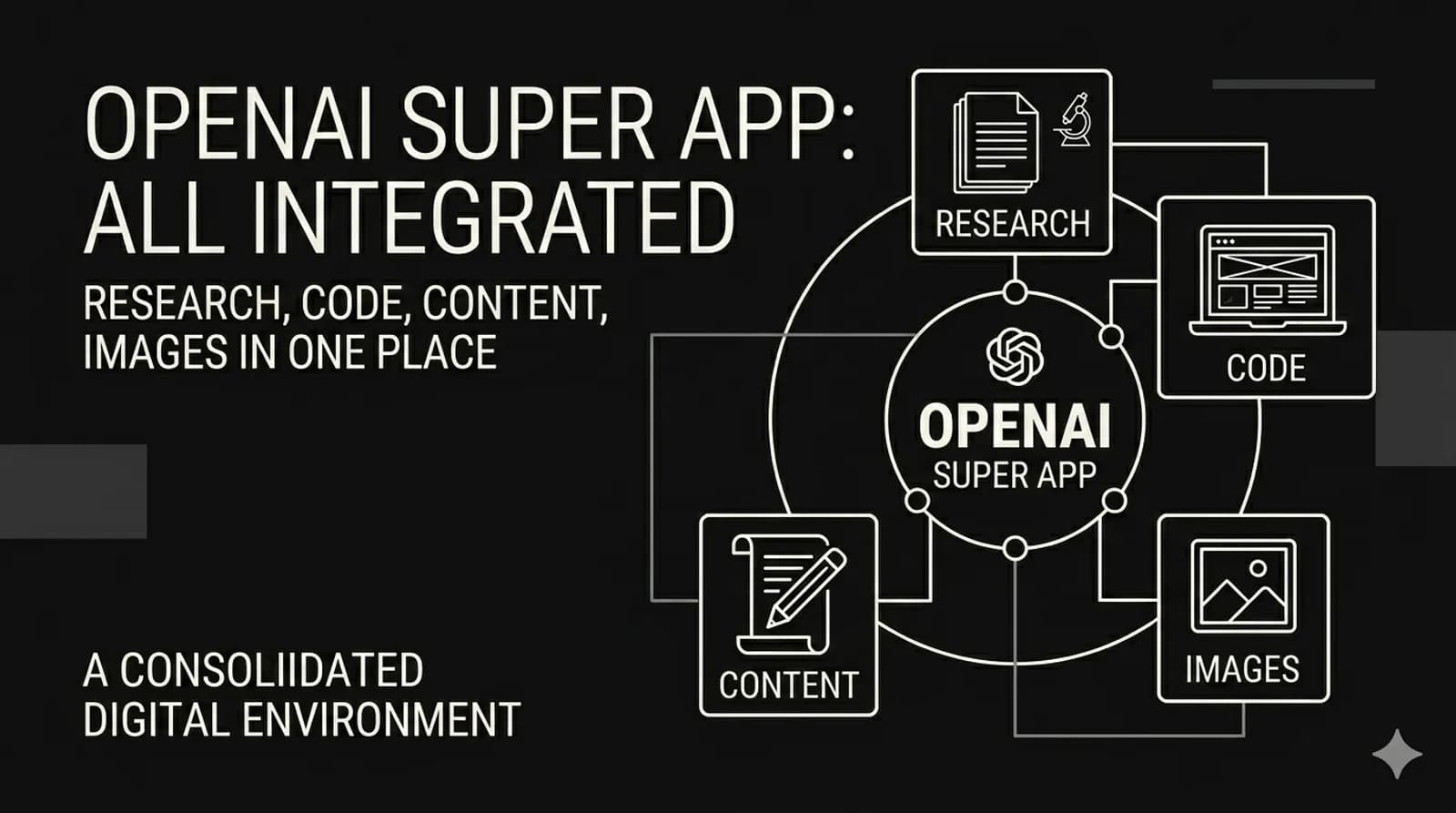
OpenAI's Super App Bet: Everything Gets Merged Into One
OpenAI just killed Sora. Not officially, but sources say the video generation team was wound down so resources could shift toward Codex. And as the alert came through, the timing felt deliberate. Side bets are over. The new priority is making OpenAI products that actually ship value, and Codex is at the center of that bet.
By the end of 2026, OpenAI plans to merge three of its biggest products into one desktop app. ChatGPT. The Codex coding app. The Atlas browser. One window. No switching. Fidji Simo, OpenAI's CEO of Applications, is running the show herself.
This is a big deal. And it might not work.
Why Now
OpenAI launched a flurry of products over the last two years. ChatGPT exploded in 2022. Then came the API. Then Sora, the browser, the Codex CLI, the Codex desktop app. Each one useful on its own. But the experience fragmented fast.
You chat with ChatGPT. You code with Codex. You browse with Atlas. Three products. Three mental contexts. Three sets of habits. For power users that works fine. For the 900 million people on ChatGPT, it is a lot to manage.
The company knows this. Simo held an all-hands meeting in March 2026 where she told employees the focus is shifting hard toward productivity. "What really matters for us right now is staying focused and executing extremely well," she said, according to a transcript reviewed by CNBC.
That is the business logic. Simplify the product. Reduce churn. Keep users inside the OpenAI ecosystem instead of hopping to Claude, Gemini, or Cursor.
But there is a deeper reason too. The IPO clock is ticking. Investors want one story, not a scattered product portfolio.
The Real Goal
Thibault Sottiaux, who leads Codex, told me that in six months he thinks the transformation that happened in coding will spread to all knowledge work. "I get more coding done than ever before, yet I don't actually write a single line of code anymore," he said. "That experience will translate to many, many fields."
That is the pitch. Codex is not just for programmers. It is a prototype for how AI changes work broadly. You give it a task, it runs for hours, you review what it did. That workflow, stripped of the coding specifics, becomes the super app.
Alexander Embiricos, Codex's product lead, put it plainly. The goal is to bring the Codex agent to ChatGPT's user base without asking anyone to learn anything new. "No modes for us," he said. "That is the goal."
Think about what that means. You open ChatGPT. You do not pick between "Chat" or "Code" or "Browser." You just have a task. The app figures out what tools to use. You review the output. That is the whole interaction.
Anthropic already moved in this direction with Claude Cowork, an interface that abstracts away coding entirely. OpenAI is responding by betting everything on the same vision.
The Atlas Browser Piece
OpenAI's browser does not get talked about enough. It launched in late 2025 and has largely flown under the radar. But it matters here.
If Codex can browse the web, write emails, run research, and manage your tasks inside a unified app, it changes what "using AI" means. Right now you paste things into ChatGPT. In the super app, the browser is part of the context. Codex sees what you see online and can act on it directly.
The Codex app already does a lot of this. It manages multiple agents in parallel. It picks up your git history and project context. It runs automations on a schedule. One user prompt generated a complete racing game using over 7 million tokens. One prompt. No manual coding.
Now imagine that running inside a browser-aware environment. That is what the super app is building toward. The browser is not just a tab. It is context. And context is everything in AI interactions.
The Risks Nobody Talks About
Here is the thing though. Merging ChatGPT, Codex, and Atlas sounds smooth in a presentation. In practice it is genuinely hard.
The three biggest failure modes:
- One mode bleeds into the other and everything feels half-finished
- The app gets too smart and starts doing things users did not ask for
- Security concerns kill enterprise adoption before it gets started
ChatGPT users come for conversation. Codex users come to get work done. These are different mental models. Different tolerances for error.
If you use ChatGPT to brainstorm and it starts running automated tasks in the background without asking, that is going to feel invasive. If you use Codex and it falls back to generic chat when things get hard, that is going to feel broken.
The "no modes" pitch is elegant. It is also extremely hard to ship without one of those modes bleeding into the other.
There is also the trust problem. Codex needs access to your files, your terminal, your browser. That is a lot of surface area. When ChatGPT is also doing coding tasks and browsing, the attack surface grows. OpenAI has not fully addressed what that looks like for security-conscious enterprises or government clients.
And then there is the switching cost. People have habits. ChatGPT users have chat habits. Codex users have workflow habits. Forcing a merge means disrupting habits that took years to form. Some users will adapt. Many will push back.
Most people do not want one app that does everything. They want the thing they need to feel simple. OpenAI is betting the opposite is true. That is a real gamble.
The Context Simo Is Working In
This is not just a product story. OpenAI is preparing for a potential IPO. The company needs a clear path to revenue and a coherent product strategy. Fragmented products do not help that narrative.
Hiring Simo, the former Instacart CEO, was a signal. She was brought in to run the applications business and bring operational discipline. The super app is the most visible expression of that shift.
She also just announced a temporary leave of absence for health reasons. The leadership transition during this critical push is worth noting. The super app does not get paused because of it, but it is a factor.
The window for this bet is tight. If the super app lands well, OpenAI becomes the default AI interface for both work and casual use. If it feels bloated or confusing, users will route around it to the individual products that do one thing well.
The Bottom Line
OpenAI is putting its most important products in one box. The reasoning is sound. The execution risk is real.
The company that changed how we talk to AI is now trying to change how we work with AI, browse the web with AI, and maybe eventually live with AI. All in one app.
Whether that app feels like a command center or a cluttered dashboard depends entirely on whether OpenAI can resist the urge to add features and actually make the core experience feel simple.
That is the hardest thing in software. And OpenAI just bet its future on it.
One app to rule them all. Or one app that tries to do everything and does nothing particularly well.
I keep thinking about that Sora team. Months of work. A product that had the whole internet talking. Shut down so Codex could get more engineers.
Maybe that is the right call. Maybe the future really is one app that does everything. But the people who built Sora probably have a different opinion.
They are not wrong to.